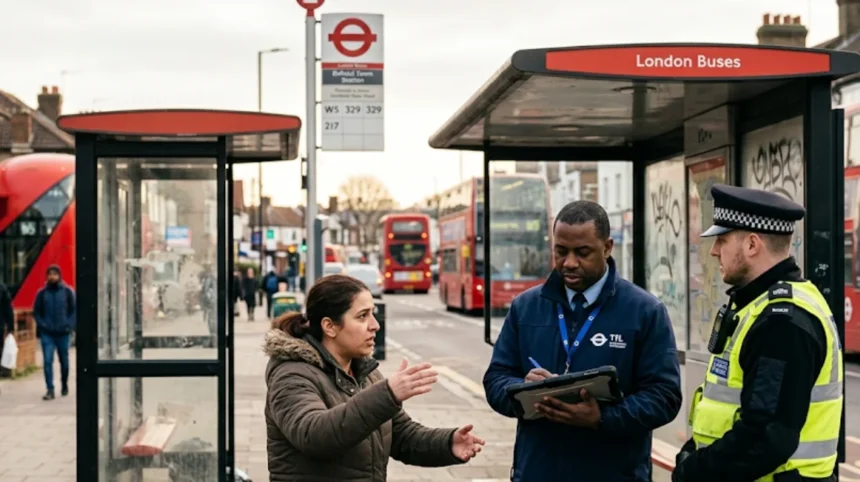
Unsafe bus stops in Enfield are reported to Transport for London (TfL), the Metropolitan Police, and Enfield Council depending on whether the issue relates to physical safety, crime, antisocial behaviour, or council responsibilities for the surrounding street environment.
- What counts as an unsafe bus stop in Enfield?
- Who is responsible for bus stop safety in Enfield?
- How do you report a physical safety hazard at a bus stop in Enfield?
- How do you report crime or antisocial behaviour at bus stops in Enfield?
- How can you report accessibility problems or unsafe buses serving Enfield stops?
- How do you report surrounding street problems that affect bus stop safety in Enfield?
- What information should you include when reporting an unsafe bus stop in Enfield?
- How are unsafe bus stop reports handled and escalated in Enfield?
- How can Enfield residents monitor and improve future bus stop safety?
What counts as an unsafe bus stop in Enfield?
An unsafe bus stop in Enfield is any TfL bus boarding point where physical conditions, crime, antisocial behaviour, poor lighting, damaged infrastructure, or traffic layout create a clear risk of injury, accident, or harm for passengers and road users.
In London, bus stops are part of the public transport network managed by Transport for London, which defines safety issues as hazards or incidents that risk injury or harm, including broken shelters, damaged signage, unsafe road layouts, and dangerous behaviour near stops. Enfield Council is responsible for highways, pavements, street lighting, and local public spaces around bus stops, so hazards such as broken pavements, unlit approaches, or obstructed footways also form part of bus stop safety.
Crime and antisocial behaviour at bus stops, such as harassment, threats, drug activity, vandalism, or aggressive groups, are defined as community safety problems and are handled through police and community safety structures. Unsafe bus stops also include locations where repeated road incidents happen near stops, such as vehicles clipping kerbs, near-miss collisions, or unsafe speed, especially when these patterns are documented by residents or police.
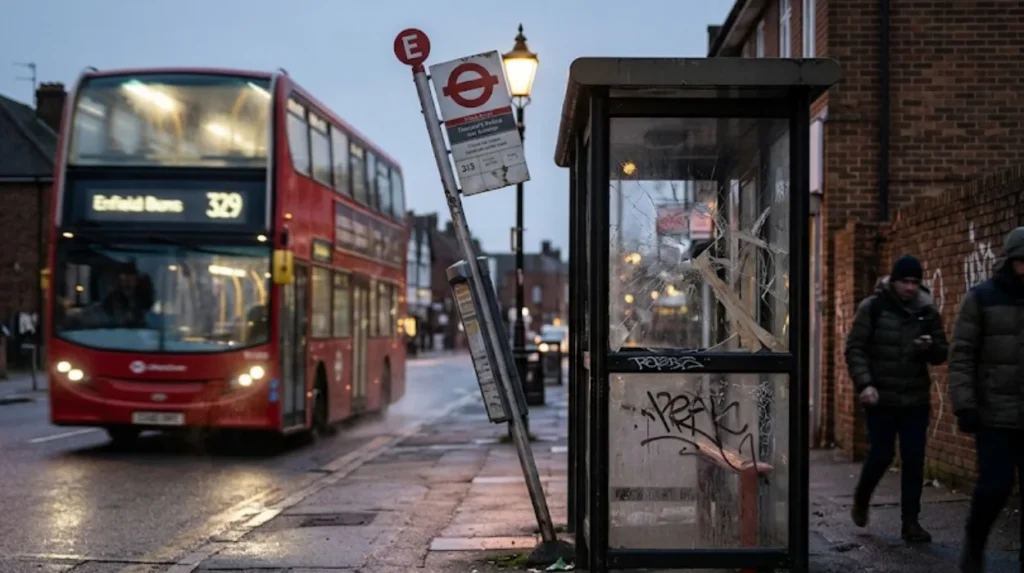
Examples of unsafe bus stops in Enfield include broken or loose shelter glass on Green Lanes, unlit rural stops on routes such as 313 where passengers wait in darkness, pavement collapses near stops on Hertford Road, or persistent antisocial gatherings at stops close to town centres. Each example shows how physical infrastructure, lighting, and behaviour around the bus stop combine to form defined safety hazards under London transport and community safety guidance.
Who is responsible for bus stop safety in Enfield?
Bus stop safety in Enfield is shared between Transport for London for bus stop assets and services, Enfield Council for highways and public space, and the police for crime and antisocial behaviour affecting passengers and nearby residents.
Transport for London manages London’s bus network, including bus stop poles, shelters, timetables, and many road markings for bus stop clearways, and operates dedicated channels for reporting safety hazards, broken equipment, and incidents on buses and at stops. TfL defines its role in handling safety hazards, injuries, and serious concerns across the transport network, with reporting routes available online, by phone and in writing.
Enfield Council functions as the local highways authority, responsible for roads, pavements, street lights, benches, bollards, and many street signs, and provides “Report a problem” services for dangerous road or footway defects near bus stops. The council also runs nuisance and community safety services that respond to local problems such as antisocial behaviour, illegal activity and environmental hazards in the vicinity of bus stops.
Police bodies, including the Metropolitan Police Service and British Transport Police, are responsible for crime, threats, assaults, and serious antisocial behaviour encountered at bus stops or on public transport. Crime reporting is handled through 999 in emergencies, 101 for non-emergencies, and specialist channels such as the British Transport Police online reporting system and text services.
If residents believe TfL or Enfield Council have not acted properly in relation to bus stops or shelters, they can complain to the Local Government and Social Care Ombudsman, which issues fact sheets explaining how it considers complaints about bus stops and shelters. Examples of responsible roles include TfL fixing broken shelter panels, Enfield Council repairing a collapsed footway leading to a stop, and police investigating persistent harassment of passengers at busy interchange points.
How do you report a physical safety hazard at a bus stop in Enfield?
To report a physical safety hazard at a bus stop in Enfield, submit a safety issue report to Transport for London, use Enfield Council’s “Report a problem” service for highways defects, and call 999 for any immediate danger or serious injury incidents at the location.
Physical safety hazards include broken bus shelters, damaged bus stop poles, unsafe road markings, dangerous obstructions, or serious defects in the pavement or carriageway where passengers board or alight. TfL advises passengers to report broken bus stops and shelters using its street care reporting tool, which is the quickest way to log issues such as damaged glass, missing panels, or obstructed bus stop areas.
When the hazard relates to the highway, such as potholes, broken kerbs, or uneven pavements near the stop, Enfield Council’s “Report a problem” page must be used to register road or pavement maintenance issues. The council lists categories including potholes, footway channel problems, road problems, street obstruction and bench or bollard problems, all of which directly affect bus stop safety when located near waiting areas.
For any incident involving injury, collapse of structures, or immediate risk to life, emergency services must be contacted through 999 and transport staff informed if present. After emergency action, residents should still log formal reports with TfL and Enfield Council so the hazard is recorded and remedial work scheduled.
Examples of physical hazard reporting include sending a TfL street care report when a shelter window shatters on Fore Street, submitting an Enfield highway defect report for a deep pothole where buses pull into a stop on Southbury Road, and calling 999 when a bus stop pole is knocked into the carriageway after a collision.
How do you report crime or antisocial behaviour at bus stops in Enfield?
Crime and antisocial behaviour at bus stops in Enfield are reported to the police using 999 for emergencies and 101 or online channels for non-emergencies, with additional contact to TfL and Enfield community safety teams for ongoing local issues.
Crime includes assaults, theft, harassment, threats, and serious disorder affecting bus users, while antisocial behaviour covers intimidating groups, vandalism, drug use, and other persistent behaviour that harms community safety at and around bus stops. TfL provides guidance on reporting crime and antisocial behaviour on the transport network, stating that passengers must call 999 in an emergency, speak to staff where possible, or use relevant police channels, including British Transport Police options for rail services.
For non-emergency crime, London residents use 101 or designated online reporting portals provided by the Metropolitan Police, giving details such as location, time, description of those involved, and impact on bus stop users. Enfield Council’s community safety information supports residents who experience worrying or inappropriate behaviour, explaining routes for advice and support to keep safe in the wider community, including at public transport access points.
Longer-term antisocial behaviour affecting bus stops, such as repeated vandalism or intimidating gatherings, can be raised with Enfield community safety teams, which coordinate local responses with police, housing, and other partners. TfL customer services also accept reports of safety and security concerns through phone and online forms, allowing patterns of behaviour on the transport network to be monitored.
Examples of reporting include calling 999 when a violent fight breaks out at a busy bus interchange, using 101 to report repeated harassment of school children at a stop on Chase Side, contacting Enfield community safety about ongoing drug-related loitering near a bus stop, and logging the location with TfL customer services for network monitoring.
How can you report accessibility problems or unsafe buses serving Enfield stops?
Accessibility problems or unsafe buses serving Enfield stops are reported to Transport for London for network issues and to the Driver and Vehicle Standards Agency for serious safety or accessibility breaches involving bus operators, drivers or vehicles.
Accessibility issues include missing or unusable ramps, drivers not deploying ramps, failure to stop close to kerbs, inaccessible information displays, and behaviour that discriminates against disabled passengers boarding at Enfield bus stops. The UK government provides dedicated guidance for reporting bus or coach services and drivers to the Driver and Vehicle Standards Agency, including accessibility problems and breaches of safety or accessibility rules.
To report an accessibility problem, passengers must provide details of the date and time, bus route number, the names of the stops where they boarded or attempted to board, and the operator’s name where known. The report can be made online, and complainants can choose to remain anonymous or provide contact information, with advice available on the implications of each choice.
For unsafe buses, such as vehicles that are not safe to drive or drivers breaking drivers’ hours rules, the DVSA Intelligence Unit accepts reports by email or phone, with instructions to include specific information about why the vehicle was unsafe and the journey affected. TfL’s safety contact routes also support reporting concerns about bus driving standards and safety incidents on routes that serve Enfield stops.
Examples include reporting a driver who repeatedly refuses to deploy the wheelchair ramp at an Enfield Town stop, informing DVSA about a bus emitting excessive smoke and showing visible mechanical faults, and contacting TfL to complain about harsh braking that causes injuries to standing passengers at busy commuter stops.
How do you report surrounding street problems that affect bus stop safety in Enfield?
Surrounding street problems that affect bus stop safety in Enfield, such as potholes, broken pavements, damaged street furniture or obstructions, are reported through Enfield Council’s online “Report a problem” service and tracked via Enfield Connected accounts.
Many bus stop safety issues are caused by the condition of the surrounding highway and public space, including uneven surfaces where passengers stand, blocked approaches, defective kerbs, oil spillages, and damaged benches or bollards near waiting areas. Enfield Council’s “Report a problem” page lists street environment categories such as bench, bollard, fence, post or sign problems, bridges and road structures, dangerous scaffolding or skips, footway channel problems, potholes, and road problems, all relevant to bus stop areas.
Residents are encouraged to report these issues online as the quickest and easiest way to resolve problems, with typical rapid response targets for some issues, such as 24 hours for certain environmental complaints like fly-tipping or missed bin collections. Users can create or use an Enfield Connected account to track the progress of reports, see updates, and keep a record of ongoing street safety concerns near bus stops.
When the problem involves nuisances such as persistent noise, pests, or other environmental issues affecting bus stop users, Enfield’s nuisances services provide specific reporting and guidance. Combining nuisance reporting with highway defect logging creates a comprehensive picture of conditions affecting bus stop safety, supporting more effective intervention by council teams.
Examples include reporting a hazardous oil spillage in the carriageway where buses stop on a busy route, logging a broken bench used by older passengers at a suburban bus stop, submitting a complaint about unlit scaffolding near a stop that obstructs the footway, and tracking each response through the Enfield Connected portal.
What information should you include when reporting an unsafe bus stop in Enfield?
When reporting an unsafe bus stop in Enfield, include the exact location, bus route numbers, date and time, detailed description of the hazard or incident, evidence such as photos, and any information about injuries, near misses, or vulnerable people affected.
TfL’s and DVSA’s reporting guidance emphasises clear, specific information such as the date and time, route number, names of stops, and operator details where available. Accurate location descriptions in Enfield must include street names, nearby landmarks, and directional details, for example “bus stop outside Enfield Town Station on Southbury Road, westbound, serving route 121.”
A detailed description of the hazard includes whether the problem relates to broken infrastructure, road conditions, lighting, behaviour, accessibility, or vehicle safety, and how it affects passengers or other road users. If injuries, near misses, or involvement of vulnerable people such as children, older people or disabled passengers occur, these details must be recorded to help categorise the seriousness of the incident.
Photographic evidence strengthens reports when submitted through online forms, as images help TfL, Enfield Council, and DVSA understand the scale, visibility and exact position of hazards at or near bus stops. Contact details allow authorities to request clarification, although anonymous reporting remains possible for some channels such as DVSA intelligence reporting and certain transport safety complaints.
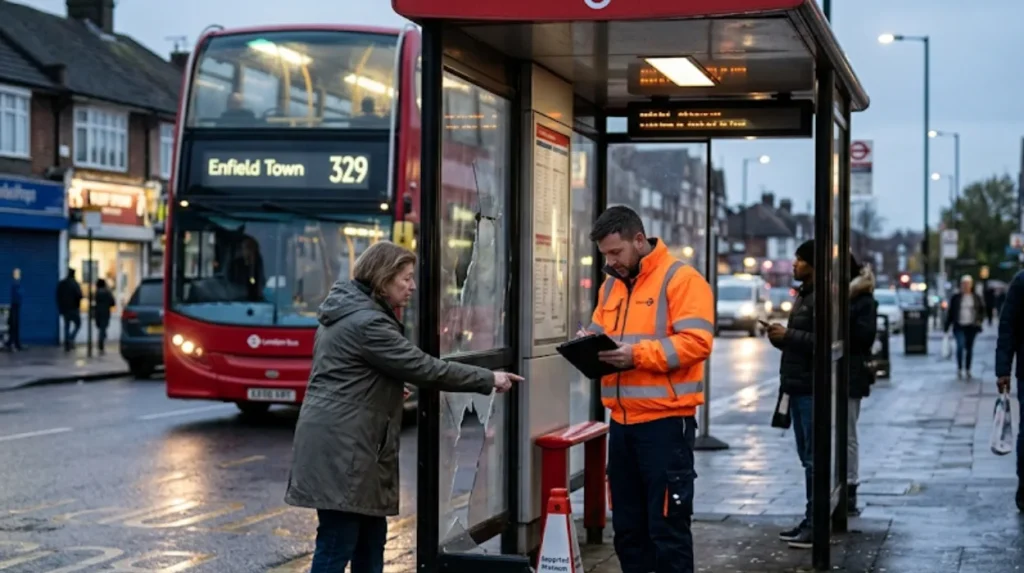
Examples of strong reports include a TfL street care submission with time-stamped photos of shattered shelter glass and an explanation of injury risk, an Enfield highway report listing exact damage dimensions at a bus stop kerb, and a DVSA email describing repeated observation of an unsafe bus with registration number and route details.
Explore More Help & Resources
Why are Enfield bus services frequently delayed?
How to report vermin problems in Enfield housing areas?
How are unsafe bus stop reports handled and escalated in Enfield?
Unsafe bus stop reports in Enfield are logged by TfL, Enfield Council and police systems, assessed for risk and responsibility, addressed within published response times, and escalated to complaint and Ombudsman processes if residents believe action is inadequate.
TfL accepts safety incident reports 24 hours a day via online forms, phone, and written contact, then directs them to the relevant bus safety and street care teams, aiming to respond to non-safety critical matters within around ten working days. Safety-critical issues, such as broken structural elements or serious hazards, are prioritised for urgent investigation and repair.
Enfield Council’s feedback and complaints guidance explains that residents must first contact the responsible service team, which acknowledges complaints within five working days and aims to resolve them within ten working days, with extensions up to twenty days if necessary. The council’s “Report a problem” service supports operational responses for road and pavement maintenance, street obstructions and related issues, with some categories resolved within specific target times such as 24 hours for selected environmental issues.
If residents remain dissatisfied after council responses and the final complaint stage, they can contact the Local Government and Social Care Ombudsman, which issues fact sheets specifically about bus stops and shelters to explain how it considers complaints about councils or, in London, TfL. Ombudsman investigations examine whether the authority followed proper procedures, considered evidence, and acted reasonably in relation to bus stop safety, rather than replacing technical judgement.
Examples of escalation include a resident first submitting repeated highway defect reports about a dangerous kerb at a bus stop, then lodging a formal complaint when repairs are delayed, and finally approaching the Ombudsman if they believe the council did not follow its own service standards. Another example involves complaining to TfL about continued failure to fix a damaged shelter after multiple reports, then using Ombudsman guidance when TfL’s actions as a transport authority appear unreasonable in relation to passenger safety.
How can Enfield residents monitor and improve future bus stop safety?
Enfield residents improve future bus stop safety by consistently reporting hazards, engaging with council and TfL consultations, tracking outcomes through online accounts, and using complaint and Ombudsman routes to ensure systematic responses to bus stop safety concerns.
Regular reporting of unsafe bus stops creates data that helps TfL and Enfield Council identify patterns, such as locations with repeated physical defects, poor lighting, or frequent incidents. This information informs maintenance priorities and longer-term infrastructure changes, such as redesigning kerbs, improving shelter design, or changing road layouts near stops.
Enfield Council and TfL often run consultations and engagement exercises on transport, highways and community safety, where residents can raise bus stop concerns alongside broader comments on walking, cycling and bus corridors. Participation in these processes helps authorities understand lived experience of bus stop safety and supports better alignment between policy and local reality.
Using Enfield Connected accounts to track reports gives residents a clear record of problem history at specific stops, enabling more informed complaints if service standards are not met. Where repeated issues remain unresolved, structured complaints and Ombudsman involvement ensure systemic review of how TfL and Enfield Council handle bus stop safety.
Examples of future-focused action include residents’ groups mapping recurring hazards at key commuter stops, parents documenting school route bus stop safety issues and presenting them in council forums, and disability advocacy organisations collating accessibility reports from DVSA and TfL responses to argue for systematic improvements across Enfield’s bus stop network.