
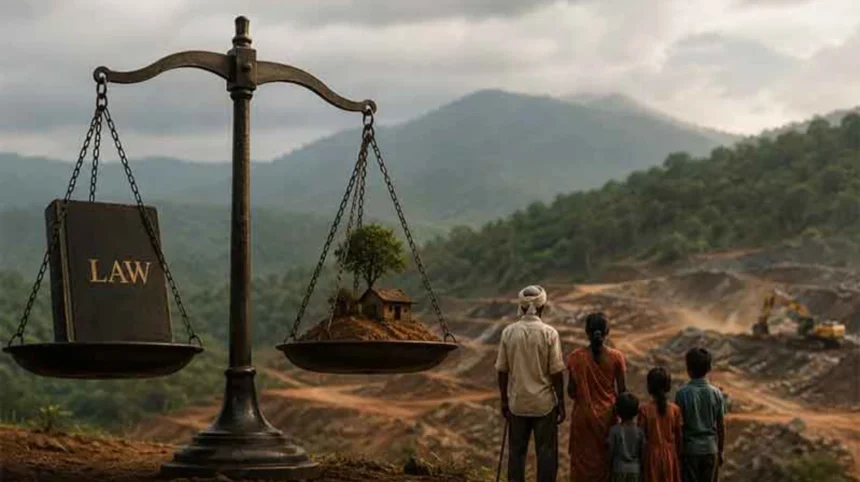
The United Nations University recently reported that humanity has entered an era of “global water bankruptcy”—a state in which long-term water usage persistently exceeds natural replenishment, permanently depleting water “savings” such as natural aquifers and glaciers. The term “water bankruptcy” describes a new global reality: humanity’s freshwater usage has so far exceeded natural replenishment that critical water systems have become insolvent and irreversibly damaged.
Under the neocapitalist framework, which prioritizes privatization, commodification, and free-market logic, water creates economic opportunity for capitalist states. No longer viewed as a limitless utility, a renewable resource, or a global common good free for all, water rights are now traded on financial markets—treating a basic human need like oil or gold. This allows corporations to corner markets and bet on scarcity. In this neocapitalist world order, water bankruptcy is weaponized through the prioritization of accumulation over reproduction. The result is often water regimes that serve corporate and industrial needs while rationing water for the poor.
The United Nations University Institute for Water, Environment and Health (UNU INWEH) has characterized water bankruptcy as a shift from a temporary crisis to a persistent state of failure. Unlike “water stress,” bankruptcy implies that historical baselines cannot be restored; the damage to aquifers and ecosystems is effectively permanent. Seventy percent of major aquifers are in long-term decline, and 75 percent of the global population now lives in water-insecure countries. The report argues that surface water and rain represent “income,” while groundwater, glaciers, and wetlands constitute “savings.” By “bankruptcy,” they mean the exhaustion of these savings, leading to a permanent state of systemic collapse.
In a neo-capitalist system, water scarcity is rarely a technical accident—it is a governance choice. In this system, supplies are diverted to protect high-value sectors such as data centers, agribusiness, and corporate industrial sites, while informal settlements, small farmers, and Scheduled Caste and Scheduled Tribe farmers face severe rationing.
The benefits of over-extraction and attendant pollution accrue to powerful users, while the environmental and social costs of extraction are socialized—or borne by peasants, landless marginalized tenants, and others. Small landholders and indigenous communities suffer the earliest and hardest impacts, leading to displacement and migration as rational responses to ecological insolvency. The loss of wetlands alone is estimated at $5.1 trillion, equivalent to the combined annual GDP of the 135 poorest countries. Half of the world’s food production occurs in areas where water storage is already unstable, creating hydrological fault lines for global trade. Due to the failure of water systems, social tensions and conflicts arise—particularly when cuts are perceived as unfair or skewed toward corporate interests.
The global water cycle is the lifeline of planet Earth. It is an enormous environmental pump, with forests transpiring moisture and replenishing atmospheric rivers of freshwater. It regulates the climate through evaporation and cloud formation. It acts as a filter, purifying water as it percolates through soils and wetlands. This global common has come under strain owing to the competing interests of neo-capitalist corporate conglomerates—who weaponize global water bankruptcy to deprive ordinary people of their rightful claim over the water cycle.
Erik Berglöf, in an article in Orissa Post, highlights this issue, noting that an estimated $7 trillion is needed to close the global financing gap for investment in water infrastructure by 2030. Multilateral development banks such as the Asian Infrastructure Investment Bank (AIIB) and the World Bank have an important role in mobilizing finance toward water cycle preservation. However, according to AIIB estimates, water-related projects account for a decreasing share (around 14%) of total development assistance. It is therefore imperative to boost investment across the water cycle—integrating natural, engineered, and digital infrastructure—promote economic reforms to align fiscal policies across borders, and mobilize private finance toward water-focused initiatives.
Emerging science and technology could transform water governance through satellite data, remote sensing, and improved modeling. These tools allow for real-time monitoring of water flows, infrastructure performance, and environmental conditions. Leveraging these technologies to improve governance would lay the groundwork for scaling up investment in the water cycle.
Neo-capitalist policies advocate for more market and less state. This has eroded social spending on water infrastructure and prevented governments from managing resources for the collective good. Addressing global water bankruptcy requires moving away from the assumption that economic prosperity requires ever-increasing water withdrawals. The economic and environmental reset requires the following policy commitments.
- Transitioning to structured recovery, transparent water accounting, and enforceable limits.
- Democratizing water management to guarantee basic human rights over corporate profit.
- Treating water as a foundational public good, halting over-extraction that causes irreversible damage to ecosystems.
- Recognizing that globalized supply chains enable virtual water trading, where water-stressed regions—especially the Global South—export water-intensive agricultural products to wealthier countries. This drains the water savings accounts of developing nations to support consumption elsewhere. This practice must be stopped.
- Acknowledging that nearly 70% of global freshwater goes toward agriculture. Neoliberal globalization incentivizes water-intensive, export-oriented cash crop farming in arid or semi-arid regions. This extraction disrupts local water cycles and fundamentally alters humanity’s relationship with nature, leading to aquifer depletion.
- Understanding that in the neoliberal framework, water is treated not as a public right but as an economic good. This facilitates the transfer of water management from state to non-state actors, who prioritize financial efficiency, debt servicing, and shareholder returns over equity and sustainable access to global commons.
The world is moving towards a more uncertain, water-insecure future, it is incumbent upon governments to ensure the restoration and maintenance of the water cycle for the common good—not for corporations. Water, needless to emphasize, is the foundation that connects every aspect of human existence. It is too risky to weaponize “water bankruptcy” to deprive people of their rightful claims over the water cycle.