The maintenance and structural remediation of public highways represent a critical operational function of local government authorities across the United Kingdom. When road surface degradation occurs, the timeframe between the submission of a citizen report and the execution of a physical repair is determined by strict statutory frameworks, risk-assessment matrices, and local council interventions. For residents and motorists across North London—encompassing administrative boroughs such as Barnet, Enfield, Haringey, Camden, and Islington—understanding these timelines requires an examination of the legal obligations placed upon highway authorities and the operational mechanisms used to restore carriageway integrity.
- What Is the Legal Definition and Background of Road Defects?
- How Long Do Emergency and Category 1 Road Repairs Take?
- What Are the Timescales for Standard Category 2 Non-Urgent Repairs?
- Why Do Certain Road Repairs Take Months to Complete?
- What Factors Delay the Standard Repair Timeline?
- How Do Citizens Successfully Report and Track Road Damage?
- What Are the Future Technical Trends and Implications for Road Maintenance?
The statutory basis for all highway maintenance in England and Wales is established under Section 41 of the Highways Act 1980. This piece of legislation imposes a strict duty on local highway authorities to maintain publicly adoptable roads within their geographic boundaries, ensuring that the network remains safe for public transit. To manage this responsibility systematically, councils do not treat all road defects equally. Instead, they operate under codes of practice, primarily the UK Roads Liaison Group’s “Well-managed Highway Infrastructure” framework. This guidelines-driven approach dictates that road repairs are prioritized based on the severity of the hazard and the operational hierarchy of the road, meaning a defect on a high-volume strategic red route will receive an accelerated response compared to an identical defect on a minor residential cul-de-sac.
What Is the Legal Definition and Background of Road Defects?
Local highway authorities define a road defect as any structural failure in the carriageway surface that meets specific depth and width criteria, requiring intervention under Section 41 of the Highways Act 1980 to ensure public safety.
To understand how long a repair takes, one must understand the exact physical definitions used by municipal engineers to classify road damage. The most frequent form of degradation is the pothole, structurally defined as a sharp-edged depression in the asphalt where the top layer of the road surface has eroded, exposing the base layers beneath. Local authorities in North London, such as the London Borough of Barnet and the London Borough of Enfield, apply exact dimensional thresholds to distinguish between minor surface wear and actionable defects.
Generally, a surface depression is legally classified as an actionable pothole when its depth exceeds 40 millimeters in the carriageway (the vehicular road surface) or 20 millimeters on a footway (the pedestrian pavement). Any degradation falling below these exact dimensions is categorized as cosmetic or low-risk, meaning the council will monitor the site during routine inspections rather than scheduling immediate maintenance crews.
The structural evolution of a pothole follows a distinct mechanical process:
- Water Ingress: Water penetrates existing micro-cracks in the top asphalt layer, a phenomenon accelerated by heavy vehicular traffic loads.
- Freeze-Thaw Cycles: During winter months, this sub-surface water freezes and expands by approximately nine percent in volume, exerting immense upward pressure on the asphalt crust.
- Cavitation: As the ice thaws, it leaves a hollow void beneath the surface. Subsequent vehicular tires compress and shatter the unsupported asphalt layer, creating a distinct, sharp-edged hole.
Historically, the administrative management of these defects relied entirely on physical highway inspectors driving fixed routes at set intervals, such as monthly, quarterly, or annually, to log issues manually. This model changed permanently with the introduction of crowdsourced digital reporting platforms. The deployment of decentralized infrastructure tools, such as the nationwide FixMyStreet platform launched by MySociety, allowed citizens to submit geolocated photographic evidence of road defects directly to local council databases (Solymosi et al., 2017). This shift shifted the macro context of highway management from a reactive, schedule-driven system to a dynamic, data-driven triaging network.
How Long Do Emergency and Category 1 Road Repairs Take?
Emergency and Category 1 road repairs take between 1 to 24 hours to resolve after a report is validated, as these defects represent an immediate, high-risk hazard to vehicular traffic, public safety, and active transport users.
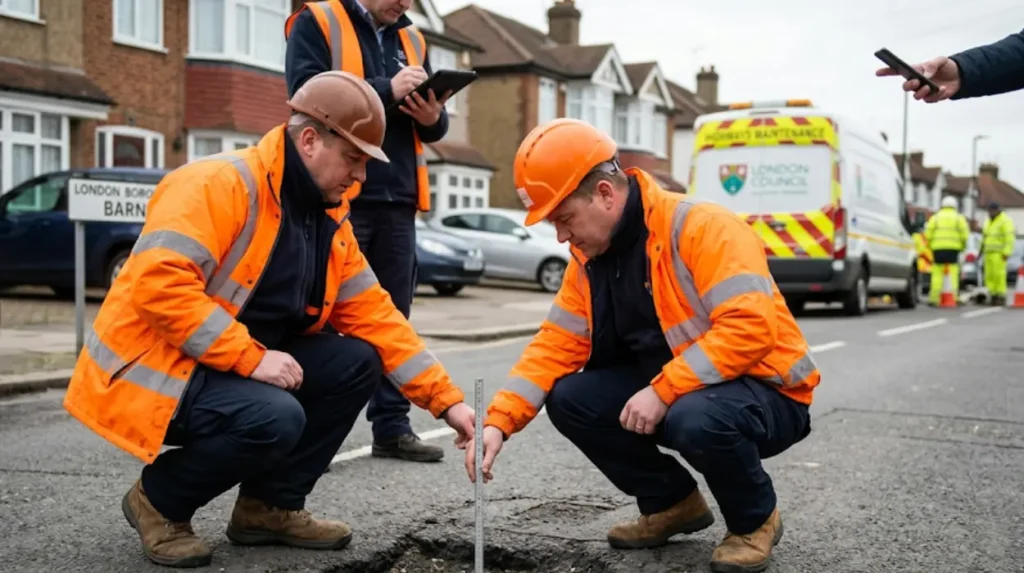
When a citizen or an official highway inspector reports a severe defect via a local authority portal, the item enters a risk-evaluation matrix. Category 1 defects—commonly referred to as emergency or critical interventions—are defined as hazards that pose an imminent threat of vehicular damage, personal injury, or catastrophic structural failure. Examples of Category 1 defects include potholes exceeding 100 millimeters in depth on primary routes, collapsed ironwork such as sewer manholes, missing drain gully grates, major structural subsidence, and large debris obstructing an active traffic lane.
For these critical hazards, North London councils operate a strict 2-hour or 24-hour intervention window, depending on the precise severity score. The specific operational targets for three prominent North London authorities illustrate this localized framework:
- London Borough of Enfield: Operates an express 2-hour target for emergency call-outs where a defect presents an immediate danger to life or property, with a standard 24-hour turn-around for high-priority structural hazards.
- London Borough of Barnet: Enforces a mandatory 24-hour repair mandate for verified Category 1 defects on its primary network, which includes strategic link roads and heavily utilized bus routes.
- London Borough of Haringey: Coordinates emergency response teams via its direct highway maintenance contractors to make an emergency site safe within 2 hours of validation, either through a permanent repair or temporary physical barriers.
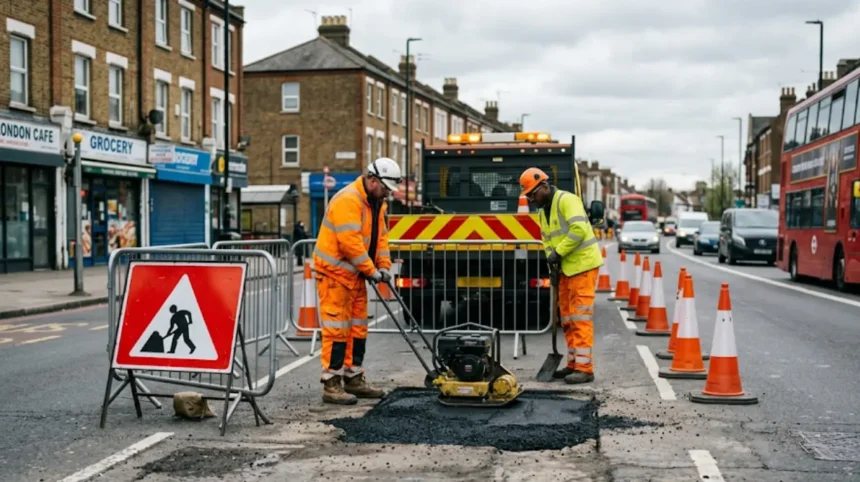
The operational workflow for a Category 1 repair requires the immediate dispatch of a rapid-response maintenance vehicle. Because time is constrained, these crews frequently use a technique known as a “throw-and-roll” or reactive cold-mix patch. This process involves clearing loose debris from the cavity, pouring a cold-mix bitumen emulsion directly into the hole, and compacting it using mechanical hand-tampers or the wheels of the service vehicle (Nazzal, 2023). While highly effective at neutralizing immediate safety risks, cold-mix patches are structurally temporary and are designed to hold the road surface stable until a permanent hot-mix asphalt replacement can be integrated into the scheduled maintenance queue.
What Are the Timescales for Standard Category 2 Non-Urgent Repairs?
Standard Category 2 non-urgent road repairs take between 7 to 28 business days to complete after validation, depending on whether the defect is classified as a high, medium, or low operational priority by council engineers.
The vast majority of road defects reported by the public do not meet the extreme safety criteria required for emergency classification. These are designated as Category 2 defects. These are sub-critical anomalies that meet the legal intervention threshold of 40 millimeters in depth but do not pose an immediate, catastrophic threat to road users. Examples of Category 2 defects include standard mid-sized potholes on residential side streets, moderate longitudinal cracking along asphalt joints, and minor pavement tripping hazards.
Councils subdivide Category 2 repairs into precise priority tiers to optimize their deployment of labor and material resources. The standard operational framework across the North London highway network follows a 7-day, 14-day, and 28-day allocation model:
- Category 2 High (7-Day Target): Applied to defects located on secondary distributor roads or near sensitive public facilities, including schools, hospitals, and major transport hubs like underground stations.
- Category 2 Medium (14-Day Target): Assigned to defects on standard residential streets that experience moderate daily traffic volumes but do not host regular heavy commercial vehicles.
- Category 2 Low (28-Day Target): Applied to minor defects on low-volume cul-de-sacs, peripheral access tracks, or rural lanes where the probability of a vehicle striking the defect at high speed is statistically minimal.
Because Category 2 repairs are planned in advance, maintenance teams use more durable structural repair methods rather than rapid cold-mix pours. The standard procedure involves a formal saw-cut patch technique. A maintenance crew cuts a clean, rectangular perimeter around the damaged asphalt using a diamond-blade road saw, excavates the compromised material down to the stable sub-base, applies a liquid bitumen tack coat to ensure adhesion, and fills the cavity with hot-mix asphalt compacted by a ride-on vibratory roller. This structural intervention provides a service life extending up to 15 years, preventing repetitive failure of the local asset (Ramdas, 2011).
Why Do Certain Road Repairs Take Months to Complete?
Certain road repairs take several months to complete because they require comprehensive structural resurfacing, extensive utility company coordination, statutory legal permits, or major capital funding allocations from regional transport bodies.
When a section of road exhibits widespread structural failure—such as extensive alligator cracking, deep rutting along vehicular wheel paths, or systemic base-course failure—simple spot-patching becomes economically inefficient and structurally futile. In these scenarios, the highway authority must design a comprehensive resurfacing scheme. These large-scale projects require extensive engineering design, procurement of commercial contractors, and integration into the council’s annual capital expenditure budget. This administrative phase routinely spans three to six months before physical construction begins.
Furthermore, a significant percentage of prolonged road delays stems from the legal division of infrastructure ownership under the New Roads and Street Works Act 1991. Local councils share the subterranean space beneath highways with private utility firms providing electricity, gas, water, and telecommunications services. When a road defect is caused by a leaking underground water pipe or a collapsing utility trench, the council cannot legally execute the repair. Instead, the authority must issue a formal Section 81 notice to the responsible utility asset owner, such as Thames Water or Cadent Gas.
Once a Section 81 notice is served, the statutory timeline passes to the utility firm. Under current regulations, utility companies are granted an extended window—often ranging from 21 days for standard defects to several months for complex network overhauls—to schedule and execute the reinstatement. This statutory division explains why a visible pothole or sunken trench may sit untouched for months despite repeated citizen reports; the local council is legally prohibited from tampering with the underlying utility infrastructure until the corporate operator completes its technical obligations.
Explore More Help & Resources
Can council be claimed against for pothole damage?
Why are parking fines issued despite valid permits?
What Factors Delay the Standard Repair Timeline?
Standard road repair timelines are delayed by adverse meteorological conditions, complex traffic management requirements, supply chain constraints on asphalt production, and local budgetary deficits within municipal highway departments.
The physical execution of an asphalt repair is highly sensitive to environmental and operational variables. Weather conditions represent a primary disruptive factor. Hot-mix asphalt must be laid and compacted at temperatures exceeding 120 degrees Celsius to achieve its intended material density and structural binding properties. If a maintenance crew attempts to lay hot asphalt during heavy rainfall or when the ambient temperature drops below freezing, the water instantly vaporizes into steam, creating internal voids, while the cold pavement chills the mix too quickly, causing premature thermal cracking (Nazzal, 2023). Consequently, during periods of prolonged winter storms or sub-zero conditions, councils must suspend permanent hot-mix patching operations, causing a backlog of reported defects.
Traffic management logistics represent another significant cause of operational delay. In densely populated urban zones across North London, repairing a defect on a major artery—such as the A10, A406 North Circular, or A1000—cannot occur without comprehensive traffic interventions. Under the Traffic Management Act 2004, councils must minimize urban congestion while ensuring worker safety. If a repair requires a partial or full road closure, the highways department must coordinate with Transport for London (TfL), issue advance public warning notices, and design safe diversion routes. Securing these statutory permits and setting up physical traffic diversions adds several weeks to the operational timeline for an otherwise simple asphalt fix.
Finally, supply chain logistics and municipal funding constraints dictate repair velocities. Asphalt production plants operate on fixed weekly schedules and require specific raw aggregates. Shortages in bitumen components or transport delays directly halt highway maintenance workflows. On a broader scale, local authorities operate within strict financial limits. If a borough experiences an unprecedented surge in winter potholes, its reactive maintenance budget can become exhausted before the end of the financial year. When this fiscal ceiling is reached, engineers must ration repair crews, prioritizing emergency interventions while deferring standard Category 2 repairs into the next funding cycle.
How Do Citizens Successfully Report and Track Road Damage?
Citizens successfully report and track road damage by utilizing digital geolocation platforms to submit precise measurements, clear photographs, and automated system alerts directly to the responsible highway authority.
To ensure a reported road defect is addressed within the standard target windows, the submitted notification must contain actionable data that allows council engineers to triage the issue without requiring a preliminary exploratory inspection. Vague descriptions, such as “large hole on High Street,” lack the spatial specificity needed to deploy a crew. Instead, citizens must provide precise geospatial data, including the exact street address, proximity to fixed landmarks like a specific house number or lamp column, and GPS coordinates captured via a mobile device.
The digital reporting ecosystem across North London relies on two primary pathways:
- Centralized National Systems (FixMyStreet): This platform allows users to drop a pin on a digital map, upload photographic evidence, and describe the hazard. The software automatically identifies the precise borough boundary and routes the data payload directly into that specific council’s asset management software.
- Direct Borough Portals: Individual local authorities maintain bespoke digital reporting interfaces on their official websites. Utilizing a borough’s direct portal often accelerates the internal processing speed, as the report skips external validation queues and enters the council’s contractor dispatch system immediately.
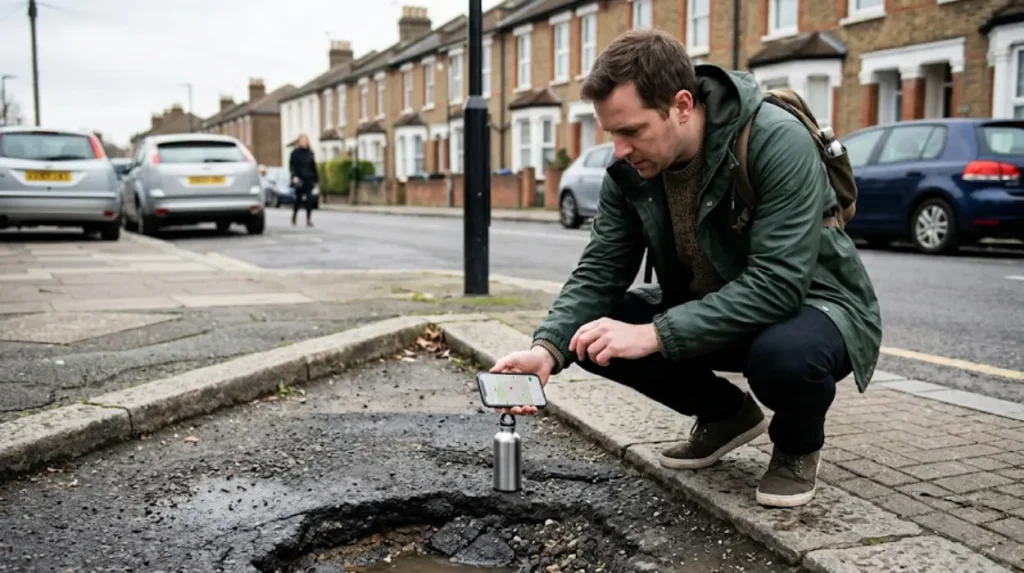
When submitting a report, including visual context is vital. Photographically documenting the pothole next to a standard reference object, such as a water bottle or a coin, allows the digital triaging team to estimate the depth and diameter instantly. Once a report is submitted, the system generates a unique alphanumeric tracking reference code. Citizens can use this identifier to monitor the administrative status of the defect. The status generally transitions through a structured sequence of operational states: Reported (submitted to database), Under Investigation (inspector dispatched to verify), Work Ordered (job assigned to maintenance contractor), and Completed (physical repair executed and verified).
What Are the Future Technical Trends and Implications for Road Maintenance?
Future road maintenance relies on automated AI-driven defect detection vehicles, self-healing materials, and predictive infrastructure software to repair damage before it poses a physical hazard to road users.
The reactive model of road maintenance—waiting for an asphalt failure to occur, relying on a citizen to report it, and deploying a manual crew—is being replaced by predictive engineering systems. Local authorities across London are actively trialing vehicle-mounted artificial intelligence (AI) computer vision systems. These systems utilize high-definition cameras installed on routine municipal vehicles, such as refuse collection trucks and buses, to continuously scan the carriageway at standard driving speeds. The integrated AI software automatically detects, measures, and logs surface fissures and early-stage potholes in a centralized GIS database, allowing councils to repair minor surface wear weeks before it transitions into an actionable Category 1 hazard.
Simultaneously, materials science is introducing advanced compounds designed to extend the lifespan of urban infrastructure. Key innovations currently entering the wider UK construction market include:
- Self-Healing Asphalt: Incorporates microscopic steel wool fibers or microcapsules containing liquid asphalt rejuvenators into the bitumen mix. When a micro-crack begins to form, induction heating or internal capillary pressure breaks the capsules, releasing the binder to automatically seal the fracture without human intervention.
- Recycled Polymer Bitumen: Integrates waste-derived plastics and processed crumb rubber from recycled vehicular tires directly into the hot asphalt mix. This chemical modification increases the elastic modulus of the road surface, rendering it more resilient to the thermal stresses of freeze-thaw cycles and reducing long-term pothole formation (Coopland & Winter, 2021).
- Cold-Applied Ultra-Thin Surfacings: Advanced polymer-modified emulsified asphalt materials that can be applied rapidly over large areas, curing within 30 minutes to provide a waterproof barrier that prevents initial water ingress.
The widespread adoption of these predictive and autonomous technologies carries major financial and environmental implications. Shifting from reactive spot-patching to proactive, automated preservation reduces the long-term lifecycle cost of highway assets by up to fifty percent. Furthermore, reducing the frequency of physical road closures directly lowers urban vehicular congestion and its associated carbon emissions. By deploying durable, waste-derived materials and predictive scheduling algorithms, local authorities can transition their highway infrastructure into a more resilient asset, ensuring long-term safety and operational continuity across the urban transit network.
How long does it take for a reported pothole to be repaired in North London?
Repair times depend on the severity of the defect. Emergency road hazards can be repaired or made safe within 1 to 24 hours, while standard non-urgent potholes are typically repaired within 7 to 28 working days.