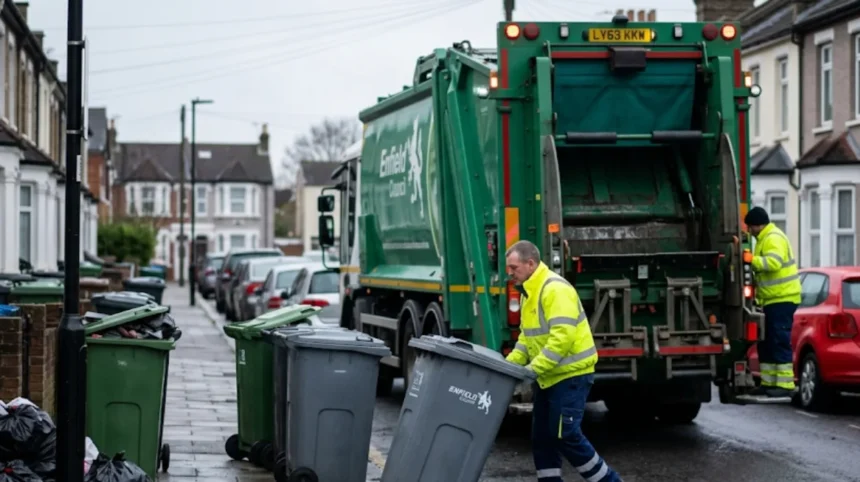
Enfield Council’s missed rubbish collections are linked to service redesign, access problems, staffing pressure, contamination in recycling, and the operational complexity of collecting waste from estates, flats, and narrow streets across a large borough. Enfield changed from weekly to fortnightly general waste collections in March 2020, and later reporting linked waste-service strain to pandemic disruption, collection access issues, and persistent fly-tipping pressure.
- Why do Enfield rubbish collections go wrong?
- What changed in Enfield’s collection system?
- Why do flats and estates face more problems?
- How does contamination affect collections?
- What role do staffing and absences play?
- Why do access and parking issues matter?
- How did fly-tipping become part of the problem?
- What do the figures show?
- What is the wider London context?
- What should residents understand?
- Why does the problem persist?
Why do Enfield rubbish collections go wrong?
The main causes are route disruption, access barriers, service capacity limits, and waste-mix problems in communal areas. Enfield Council has said its waste service has faced pressure from staff absences, while separate reporting has pointed to contamination in recycling, seasonal disruption, and operational difficulty serving flats and mixed housing.
Enfield is not a single housing pattern. It contains houses, estates, flats above shops, and purpose-built communal bin areas. That creates different collection needs in different streets. A scheduled lorry can complete one road and then fail in another because parked cars, gated access, blocked bin stores, or contaminated waste slow the round.
Missed collections also arise when the service is organised around a fixed timetable but real-world conditions change daily. A crew can be delayed by vehicle problems, road access, overloaded bins, or waste left in the wrong format. In a dense borough, one failed stop affects the rest of the route and leaves waste behind until the next round.
What changed in Enfield’s collection system?
Enfield moved from weekly to fortnightly general waste collections in March 2020, and that change altered the volume, timing, and pressure on each round. The council introduced fortnightly collections as part of a wider waste strategy designed to save money and improve recycling performance.
The change was controversial from the start. Reporting from the period shows the council said the switch would help recycling and save money, while critics argued it would increase litter, fly-tipping, and the amount of rubbish left out on streets. That debate matters because collection frequency affects how quickly bins fill up and how often residents need extra capacity.
There is also a structural point. Enfield’s later waste plans did not apply equally to every property type. Some homes use wheelie bins, some use bags, and many flats rely on communal facilities. That mixed model creates uneven service standards and makes missed collections more likely where one system does not fit the property.
Why do flats and estates face more problems?
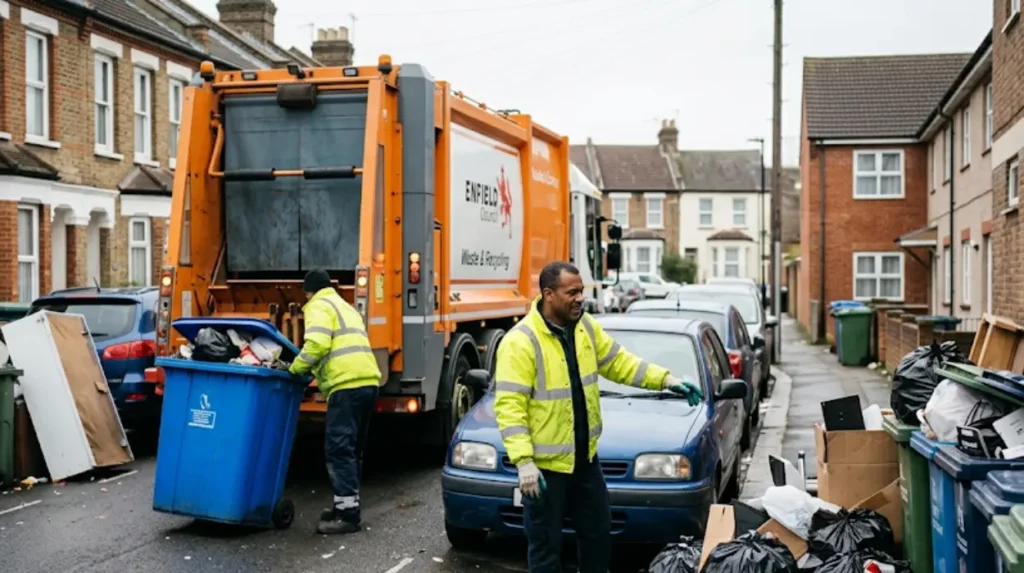
Flats and communal estates create the highest collection pressure because many households share the same bins and the same access points. Enfield’s own service changes have included extra refuse collections on council estates and larger vehicles for flats above shops, which shows the council recognises that standard rounds do not work well everywhere.
Shared bin stores fill quickly when use is high or when capacity is too small. If residents add waste faster than crews can remove it, bins overflow and crews face contaminated, split, or inaccessible waste on the next visit. That becomes a feedback loop: overflow attracts fly-tipping, which adds volume, which slows the next collection.
One example is the handling of communal bins in Enfield Wash, where a resident reported bins removed after alleged misuse and the council cited fly-tipping, vermin risk, and fire safety. That shows how waste problems in communal settings often go beyond simple missed lifts and become a management issue involving housing, access, and enforcement.
How does contamination affect collections?
Contamination means putting the wrong material in recycling bins, and it reduces collection efficiency because loads need extra sorting or disposal. Enfield reporting showed that in 2020/21 around a quarter of recycling collected from wheeled bins had to be sent for incineration because it was contaminated.
That matters operationally because contaminated recycling is not just a recycling issue. It creates extra handling, extra cost, and extra risk that crews will reject or delay a load. Enfield said targeted schemes cut wrongly placed items in recycling bins by 98%, showing how much time and resource contamination can consume when it is widespread.
The council’s recycling figures also show why waste policy and missed collections connect. Enfield’s recycling rate fell from 33.2% in 2020/21 to 30.9% in 2021/22, despite the fortnightly system being introduced partly to improve recycling. Lower recycling performance adds pressure to the service because more material remains in general waste streams.
What role do staffing and absences play?
Staff shortages and absences reduce the number of crews available to complete rounds on time. Enfield Council has publicly said its workforce was down by 17% because of general absences and the impact of coronavirus, which placed “incredible amounts of pressure” on the service.
When a waste crew is absent, managers usually reassign vehicles, combine routes, or delay collections. Those responses protect the service overall, but they also create missed bins on specific roads. A borough-wide waste system depends on enough drivers, loaders, mechanics, and support staff being available every day.
This is especially important in London, where boroughs are responsible for collecting waste and recycling, not the Mayor of London. That means Enfield must maintain its own staffing, fleet, and route design while also meeting wider recycling and climate targets set through London’s environmental strategy.
Why do access and parking issues matter?
Access issues are a major reason bins stay uncollected because a truck cannot empty what it cannot safely reach. Enfield contains many narrow residential roads, parked cars, shared access ways, and bin stores that are hard for large vehicles to reach.
A missed collection does not always mean a failure to turn up. Sometimes the crew arrives but cannot complete the lift because a vehicle blocks the street, the bin store is locked, or waste has been left in a way that prevents safe handling. In operational terms, access is a service condition, not a side issue.
This affects the borough unevenly. Streets with lower parking pressure and good access are easier to serve than estates with tight courtyards or mixed-use access points. Enfield’s own use of larger vehicles for flats above shops shows that standard collection trucks do not solve every access problem.
How did fly-tipping become part of the problem?
Fly-tipping increases missed-collection pressure because dumped waste competes with household waste for space, access, and removal time. Enfield reporting has repeatedly linked waste issues to litter, fly-tipping, and bin misuse, with the council responding through enforcement, extra collections, and free bulky waste removal.
When waste is dumped beside bins, crews often cannot lift the remaining household waste efficiently. They then need separate clearance support or enforcement follow-up. That slows the round and leaves residents with the impression that collections were missed, even when the main problem was blocked access or overfilled communal capacity.
Enfield has said it uses a dedicated enforcement team to tackle fly-tipping and has issued fixed penalty notices for offences. The need for enforcement shows that bin collections and street cleanliness are linked systems. Weak control in one area places more pressure on the other.
What do the figures show?
The figures show a borough under sustained waste pressure rather than a one-off failure. Enfield’s household recycling rate was 30.9% in 2021/22, down from 33.2% the year before, and the council’s climate action plan had set a much higher recycling goal of 49% by 2022.
That gap matters because missed collections often appear in systems that are already struggling with capacity, contamination, and route complexity. When a waste service misses targets on recycling and deals with repeated complaints, the round structure becomes more fragile and residents experience more delays.
A Local Government and Social Care Ombudsman decision also found fault where the council repeatedly failed to collect a resident’s waste, including a period when bins were not collected for 10 weeks and the council missed 12 collections since February 2020. That case shows that repeated missed collections are not just anecdotal; they can amount to proven administrative fault.
Explore More Help & Resources
How long do council housing repairs take in Enfield?
What rights apply when repairs are ignored in Enfield housing?
What is the wider London context?
Enfield’s waste issues sit inside a wider London system where boroughs control collections and must meet ambitious recycling targets. The Mayor of London’s strategy sets a goal for London to recycle 65% of waste by 2030, while also pushing boroughs to provide standard recycling services and more food waste collections.
London-wide policy also explains why councils tighten collection models. The Mayor has said boroughs need minimum service standards and investment to improve recycling and reduce waste to landfill. Enfield’s own changes, including fortnightly residual waste and extra work on contamination, fit that policy direction.
The result is a trade-off. Councils try to reduce disposal costs and improve recycling, but if the household system lacks enough bins, staff, access control, or resident compliance, the service can become more failure-prone. That is how a policy designed to improve waste management can still produce more complaints about missed collections.
What should residents understand?
Residents should understand that a missed collection in Enfield usually reflects a service failure, an access problem, or a bin-format issue, not a random event. The most common drivers are route pressure, communal-bin overflow, contamination, parking restrictions, and staffing disruption.
Residents also need to know that the council provides a formal missed-collection reporting route through its service page, and GOV.UK directs Enfield residents to the council’s own system for this purpose. Reporting quickly matters because it helps crews identify whether a problem is isolated or part of a repeated route failure.
For the borough as a whole, the issue is structural. Enfield’s missed rubbish collections happen because the service has to cover many property types, operate under budget pressure, and manage contamination, fly-tipping, and access constraints at the same time. That combination makes frequency problems more likely in certain streets and housing types than in others.

Why does the problem persist?
The problem persists because the underlying system still combines high operational complexity with limited tolerance for disruption. Enfield’s waste model must serve houses, flats, estates, and mixed-use streets while meeting recycling targets and controlling costs.
Once a borough moves from weekly to fortnightly residual waste, any disruption becomes more visible. A single missed round leaves residents waiting longer, bins overflow sooner, and complaint volumes rise faster. That pressure is strongest where shared bins, contamination, and fly-tipping already exist.
The evidence from council reporting, local coverage, and an ombudsman case points in the same direction. Enfield’s missed rubbish collections are not caused by one single fault. They come from a cluster of service design, staffing, access, and waste-handling problems that interact across the borough.
What should I do if my rubbish bin was not collected in Enfield?
If your rubbish bin was not collected, first check your scheduled collection day, make sure the bin was presented correctly, and confirm there were no access or contamination issues. If everything was correct, report the missed collection through Enfield Council’s online waste service as soon as possible. The council states that valid missed collections are normally returned to within 48 hours.