
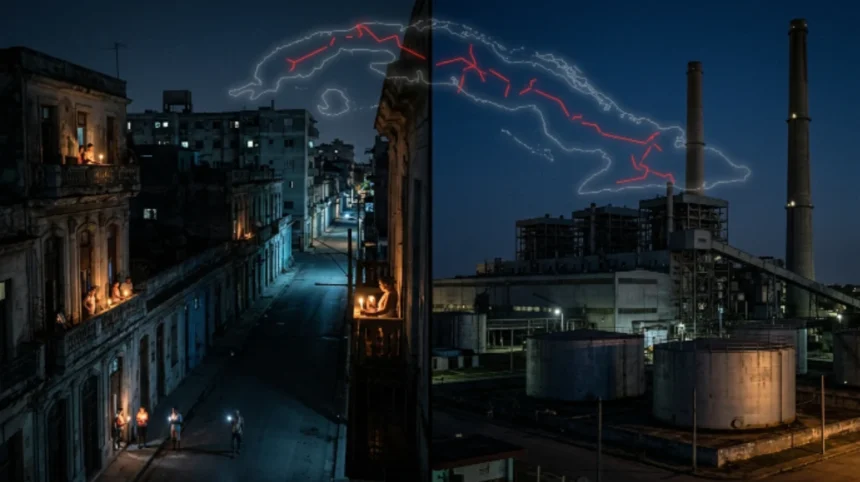
Cuba’s ten million residents are enduring a nationwide blackout for the third time in six months. The state-run electric utility has launched an investigation, but for ordinary citizens, living without power is an untold agony. The impoverished island is struggling to keep the lights on through sheer collective will, despite what it calls the inhumane U.S. blockade. President Miguel Díaz-Canel has accused Washington of trying to provoke a “social explosion through asphyxiation.” The latest collapse of the national grid stems from a dire shortage of fuel for thermoelectric plants and the failure of aging infrastructure. The energy crisis has been severely exacerbated by a de facto U.S. oil embargo that blocks shipments and creates chronic shortages nationwide. The widening deficit between generation and residential-commercial demand breeds systemic instability, often triggering a cascading failure that disconnects the entire grid. Aggressive U.S. sanctions and tariff threats against international suppliers attempting to sell or deliver oil to the island have effectively choked off necessary fuel imports. Since Cuba imports over half of its fuel, its oil reserves have been severely depleted, making it nearly impossible to keep power plants running continuously.
The consequences are devastating. Public transport has largely ground to a halt, and officials have canceled tens of thousands of elective surgeries. In Havana, the streets are dark and empty, save for lights flickering from hotel windows powered by private generators. Internet services are severely disrupted. Provinces as far away as Guantánamo, Artemisa, Santiago de Cuba, and Santa Clara have reported similar outages, with only occasional flickers of light. For residents, the uncertainty is unbearable. Lina May, 36, wondered when the power would return so she could cook rice.
“I just told my dad that we have to buy charcoal, because otherwise we can’t eat and we will starve,”
she said. Richard Valdés, 40, expressed similar frustration:
“The outage is just the latest hit of many. We are without power again. Now we have no water, no gas, nothing—until they restore it.”
María Pedroso added resignedly,
“Oil hasn’t come in for a while, and we have no way to solve the problem. We have to resist, as we Cubans say. That’s all.”
As Cuba produces only 40 percent of its fuel needs, it relies heavily on foreign partners. Russia sent 730,000 barrels in March 2026, but those supplies ran out by April, forcing the government to ration power with outages that can stretch beyond 24 consecutive hours. Peak-hour demand is estimated at around 3,250 megawatts, while the deficit reaches approximately 1,380 megawatts—meaning 42 percent of the national energy system is effectively shut down. Energy Minister Vicente de la O Levy said officials are working to restore service and have activated emergency “microsystems” to power vital services. The crisis has strained essential sectors, including education, health, transport, water supply, and tourism. Fresh sanctions have further deteriorated Cuba’s economy and deterred tourists. In a CNN interview, Cuban Foreign Trade Minister Oscar Pérez-Oliva Fraga accused the U.S. of “collective punishment” and called the situation “genocide.” The U.S. unabashedly states that its economic stranglehold is meant to force Havana to pry open its hermetic political system and allow direct foreign investment. Washington has maintained a near-total trade embargo since 1962, costing Cuba an estimated $130 billion in lost revenue. The international community has repeatedly rejected the legitimacy of this embargo, but to no avail.
Last month, Cuba‘s National Assembly approved a broad set of economic reforms aimed at opening the economy, though the Foreign Trade Minister insisted these were not enacted under external pressure. A U.S. State Department spokesperson dismissed the measures as “modest, long overdue, and superficial smoke signals.” Meanwhile, Washington accuses Cuba of hosting Russian and Chinese listening posts that thwart American interests—allegations Havana unequivocally denies. Access to fuel has become a geopolitical battleground for Cubans. This crisis is the product of a deliberate escalation of U.S. economic coercion, wielding sanctions and tariffs as twin weapons. Critics argue this economic warfare constitutes a state crime by a transnational power, paralyzing lawful trade, undermining international legal norms, and generating severe humanitarian consequences. In the words of President Díaz-Canel, the situation is a “social explosion through asphyxiation.” The Cuban blackout, many contend, is also a blackout of multilateralism and the U.N. Charter. As sociologist José Atiles justifiably comments:
“For the international legal order, the consequence is the erosion of multilateral norms and the expansion of extraterritorial coercion. Economic warfare is often presented as targeted and precise, but when they disrupt energy systems, their effects are widespread and indiscriminate.”