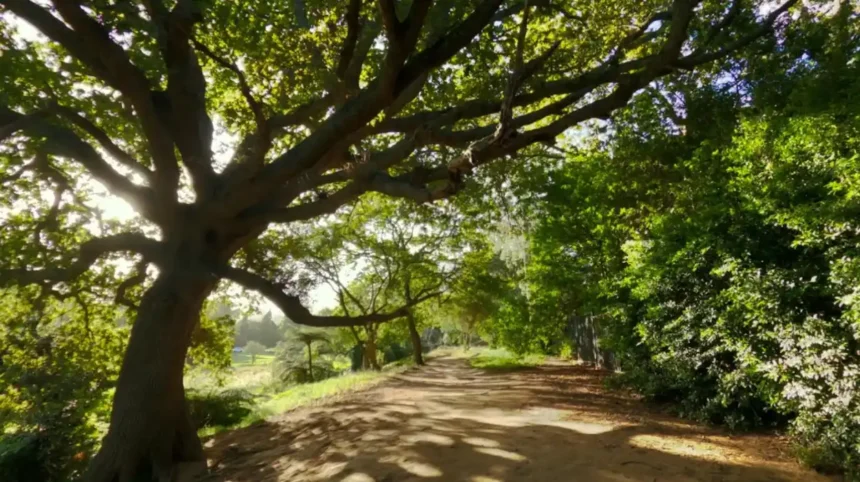
Tree cover plays an essential role in Barnet’s environment by cooling urban areas, improving air quality, supporting wildlife, managing rainwater and contributing to public health. The London Borough of Barnet contains extensive tree cover across residential streets, parks, gardens and woodlands, making trees an important part of its green infrastructure. Greater London Authority (GLA) estimates published in 2024, based primarily on 2022 data, recorded tree canopy cover across Barnet at 24.12% of the borough’s land area. This means tree crowns covered almost one-quarter of Barnet in the assessment.
- What does tree cover mean in Barnet?
- How much tree canopy cover does Barnet have compared with London?
- How does tree cover improve air quality in Barnet?
- How does tree cover reduce heat in Barnet’s urban areas?
- How does tree cover help manage rainfall and flooding in Barnet?
- How does tree cover support wildlife and biodiversity in Barnet?
- What role do Barnet’s parks and woodlands play in tree cover?
- How does tree cover contribute to health and wellbeing?
- How do trees help reduce noise and improve neighbourhood environments?
- How does tree cover contribute to climate change mitigation?
- How does Barnet manage tree planting and tree protection?
- What challenges threaten tree cover in Barnet?
- How can residents and visitors help protect Barnet’s trees?
- What does the future of tree cover mean for Barnet?
Barnet’s trees serve residents, visitors, businesses and local wildlife. Their benefits extend beyond attractive streets and shaded walking routes. Trees regulate temperatures, intercept rainfall, store carbon and create habitats for birds, insects and other organisms. They also help make parks and neighbourhoods more comfortable places to spend time outdoors.
Understanding tree cover helps explain how Barnet responds to environmental pressures, including hotter summers, surface-water flooding, air pollution and biodiversity loss. It also shows why protecting mature trees and planting suitable new trees are important considerations in the borough’s long-term development.
What does tree cover mean in Barnet?
Tree cover describes the land area covered by the crowns of trees when viewed from above. In Barnet, this includes tree canopies in parks, gardens, streets and woodlands. It measures the spread of tree crowns rather than the number of individual trees.
Tree cover is commonly measured as tree canopy cover, expressed as a percentage of a defined area. A borough with 25% canopy cover has tree crowns extending over approximately one-quarter of its land area when measured using the relevant mapping method.
The measurement includes trees growing on both public and private land. Public examples include roadside trees and trees in parks, while private examples include mature trees in residential gardens and institutional grounds.
Tree canopy cover is different from total green cover. Green cover also includes vegetation that is not trees, such as grass, shrubs and other plants. The GLA’s 2024 assessment estimated Barnet’s tree canopy cover at 24.12%, compared with green cover of 56.40%. These figures use modelled estimates primarily based on 2022 data, rather than a direct count of every tree.
The distinction matters when assessing environmental benefits. A grassy park provides recreational space and supports some wildlife, but mature trees add overhead shade, taller vegetation and additional habitat structures. Both types of green infrastructure contribute to the borough’s environmental quality.
Tree cover also changes over time. Trees grow, branches spread and new planting establishes additional canopy. Tree removal, disease, storm damage and construction reduce cover. Monitoring canopy cover therefore provides a way to assess changes in Barnet’s urban environment.
How much tree canopy cover does Barnet have compared with London?
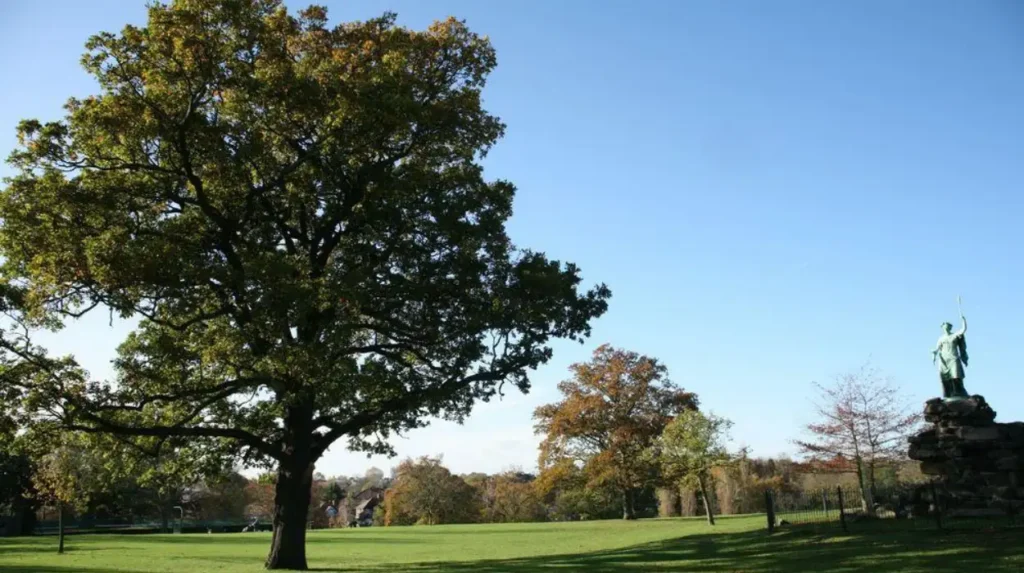
The Greater London Authority’s 2024 assessment estimated Barnet’s tree canopy cover at 24.12%, compared with 19.56% across Greater London. The assessment used aerial imagery, infrared imagery and height data, with estimates primarily based on observations from 2022.
Barnet’s estimated canopy cover was approximately 4.56 percentage points higher than the London-wide estimate. This comparison places the borough above the capital-wide average in the published assessment.
The figures require careful interpretation. They describe the proportion of land covered by tree crowns, not the proportion of residents living near trees or the percentage of streets shaded throughout the day. Two neighbourhoods with similar canopy percentages also have different environmental conditions when their trees differ in height, species, health and distribution.
Barnet Council’s earlier tree policy reported a canopy cover figure of approximately 27%, illustrating why dates and assessment methods matter when comparing published statistics. The council’s 2023–2028 tree policy also identified tree planting, street-tree replacement and the preservation of mature trees as important priorities.
The more recent GLA estimate provides a consistent borough-level comparison with other London boroughs. It does not indicate that every neighbourhood enjoys equal access to shade or green space.
For visitors, these figures help explain the green character of many parts of Barnet. For residents and planners, they provide a baseline for assessing whether future development, tree planting and conservation efforts maintain or increase the borough’s canopy.
How does tree cover improve air quality in Barnet?
Trees help improve local air quality by capturing some airborne particles on their leaves and branches, absorbing certain gaseous pollutants and influencing how air moves around streets. Their benefits depend on tree species, canopy structure, weather, traffic levels and the surrounding urban layout.
Road traffic produces pollutants that affect air quality across urban areas. These include nitrogen dioxide and fine particulate matter, which are associated with respiratory and cardiovascular health risks. Trees contribute to urban air-quality management, although they do not replace emission controls or cleaner transport.
Leaves and branches intercept some airborne particles. Rainfall subsequently washes some deposited material onto the ground. Trees also absorb carbon dioxide during photosynthesis, although carbon dioxide reduction and the removal of local air pollutants are separate environmental processes.
Barnet Council identifies air-pollution mitigation as one of the benefits of the borough’s trees. Its tree-planting policy includes planting in areas with poor air quality as one of its priorities.
Tree placement is important. Vegetation along suitable roads and pedestrian routes helps create greener environments, but dense tree canopies in narrow streets with limited air circulation sometimes restrict the dispersion of traffic pollution. Effective planting therefore considers street width, airflow, tree dimensions and the location of pollution sources.
For people walking around Barnet’s town centres and residential districts, trees contribute to the wider environmental quality of public spaces. However, their presence does not guarantee clean air. Monitoring pollution, reducing vehicle emissions and planning streets carefully remain essential.
How does tree cover reduce heat in Barnet’s urban areas?
Tree cover reduces urban heat through direct shade and evapotranspiration. Canopies block sunlight from reaching pavements, roads and buildings, while trees release water vapour through their leaves. These processes help lower surface temperatures and improve comfort during warm weather.
Urban surfaces absorb solar energy during the day and release stored heat later. Roads, roofs and paved spaces contribute to the urban heat island effect, in which built-up areas become warmer than surrounding less-developed areas.
Trees interrupt this process by shading exposed surfaces. A shaded pavement receives less direct solar radiation than an unshaded pavement, reducing the amount of heat absorbed. Trees also move water from their roots through their tissues and release it into the atmosphere as water vapour. This process, known as evapotranspiration, uses energy and contributes to cooling.
Barnet’s tree cover supports this function in streets, parks, residential areas and other outdoor spaces. The council’s tree policy identifies urban warming as a priority for planting programmes.
The cooling effect depends on the size and density of the canopy, the availability of water, local wind conditions and the surrounding surfaces. Mature trees generally provide more extensive shade than newly planted saplings because their crowns cover a larger area.
For tourists and leisure travellers, shaded walking routes and parks provide useful places to pause during warm weather. For residents, tree-lined streets and gardens help moderate exposure to heat near homes and workplaces.
Future planting is particularly relevant as climate change increases the need for urban heat adaptation. Choosing tree species suited to future temperatures and periods of drought helps maintain these benefits over time.
How does tree cover help manage rainfall and flooding in Barnet?
Trees help manage rainfall by intercepting water on their leaves and branches, allowing some rain to evaporate before reaching the ground. Their roots and surrounding permeable soils also support infiltration, reducing surface runoff and helping manage localised flood risk.
Rainfall becomes surface runoff when it flows across roofs, pavements, roads and other surfaces that absorb little water. During heavy rain, drainage systems face greater pressure as runoff enters gullies, pipes and watercourses.
Trees influence this process in several ways. Their canopies intercept a proportion of rainfall, while trunks and branches direct water towards the ground. Leaf litter and healthy soil improve the ground’s ability to absorb and retain moisture. Tree roots also contribute to soil structure, although infiltration depends on soil type, compaction and drainage conditions.
Barnet Council identifies reducing localised flooding as one of the environmental benefits of trees. Its highways tree-root policy also promotes permeable surfaces around trees as part of Sustainable Drainage Systems (SuDS). SuDS are measures designed to manage rainwater close to where it falls, rather than directing all runoff immediately into conventional drainage networks.
How do permeable surfaces support trees?
Permeable surfaces allow water to pass through or around a surface into the underlying ground. Examples include suitable permeable paving, unsealed planting areas and rain gardens designed to collect runoff.
These features support urban trees by improving water availability around roots and reducing the volume of runoff entering drainage systems. Their effectiveness depends on the underlying soil, maintenance and local drainage conditions.
Barnet’s approach to tree-root management recognises the importance of balancing pavement safety with suitable growing conditions. Well-designed tree pits and adequate rooting space help trees establish while supporting the wider drainage system.
Trees do not eliminate flood risk. Heavy rainfall, saturated soils, blocked drains and limited infiltration still produce flooding. Their contribution forms part of a wider approach that includes drainage maintenance, permeable surfaces and appropriate land-use planning.
How does tree cover support wildlife and biodiversity in Barnet?
Tree cover supports biodiversity by providing food, shelter, nesting locations and movement routes for wildlife. In Barnet, trees in gardens, streets, parks and woodlands contribute to habitats for birds, bats, insects, fungi and other organisms that depend on healthy urban ecosystems.
Biodiversity describes the variety of living organisms and the ecological relationships between them. Trees contribute to biodiversity because they create habitats at different heights, from roots and leaf litter to branches, bark, flowers and tree crowns.
A mature tree supports a wider range of ecological functions than its trunk and leaves alone suggest. Its flowers provide resources for pollinating insects, its leaves support plant-feeding invertebrates, and its branches offer nesting and resting locations for birds. Cavities and loose bark provide shelter for some bats and other wildlife where suitable conditions exist.
Barnet Council identifies habitat provision as a major benefit of its trees. It also highlights the value of considering wildlife potential in green spaces and selecting bee-friendly trees where appropriate.
Which wildlife benefits from Barnet’s trees?
Several groups of wildlife benefit from tree cover, including garden birds such as blue tits and robins, pollinating insects such as bees, and mammals such as bats. The species present depend on habitat quality, tree type, nearby vegetation and the availability of water and food.
Native trees often support established relationships with local insects and other organisms. Examples include oak trees supporting numerous invertebrates and flowering trees providing nectar and pollen. Non-native trees also contribute to urban habitats, although their ecological value varies by species.
Deadwood is another important habitat feature. Fallen branches, standing deadwood and decaying wood support fungi and invertebrates. Where safety allows, retaining suitable deadwood in managed woodland improves habitat diversity.
Why are connected green spaces important?
Wildlife benefits increase when trees form part of a connected network of habitats. Tree-lined streets, garden trees, hedgerows and woodland edges help some species move between feeding and nesting locations.
Isolated trees remain valuable, but connected green spaces provide more opportunities for movement and access to resources. Protecting existing mature trees and improving links between parks and woodland therefore supports ecological resilience across Barnet.
What role do Barnet’s parks and woodlands play in tree cover?
Barnet’s parks and woodlands form an important part of the borough’s tree-cover network. They provide space for mature trees, recreation and wildlife habitats, while linking urban neighbourhoods with larger areas of vegetation and supporting local environmental resilience.
Tree cover occurs across many land types rather than in one continuous forest. Public parks contain trees along paths, lawns and boundaries. Woodlands provide more concentrated tree cover, often with layers of shrubs, ground vegetation and decaying organic material. Residential gardens and street trees extend this network into built-up areas.
Barnet’s tree policy describes a substantial resource of street trees, greenspace and woodland. A council announcement published in 2023 referred to more than 30,000 street trees and 848 hectares of greenspace and woodland, alongside a borough-wide total exceeding 52,000 individual trees in the figures cited at that time. These historical figures should not be treated as a current inventory without checking for later updates.
Hampstead Heath
Hampstead Heath is a well-known destination on the southern edge of the wider North London area. Its woodland areas and mature trees provide opportunities to observe how tree cover contributes to recreation and wildlife habitat. Check access information before travelling.
Friary Park
Friary Park combines landscaped green space with established trees and walking areas. It provides a local example of how trees contribute to shade, park character and outdoor recreation within a residential setting.
Monken Hadley Common
This common offers a mixture of open space and tree cover. Its landscape illustrates the importance of retaining varied habitats rather than relying on tree canopy alone.
These destinations illustrate different relationships between trees and public space. Visitors should check current access arrangements, seasonal conditions and local conservation guidance before visiting.
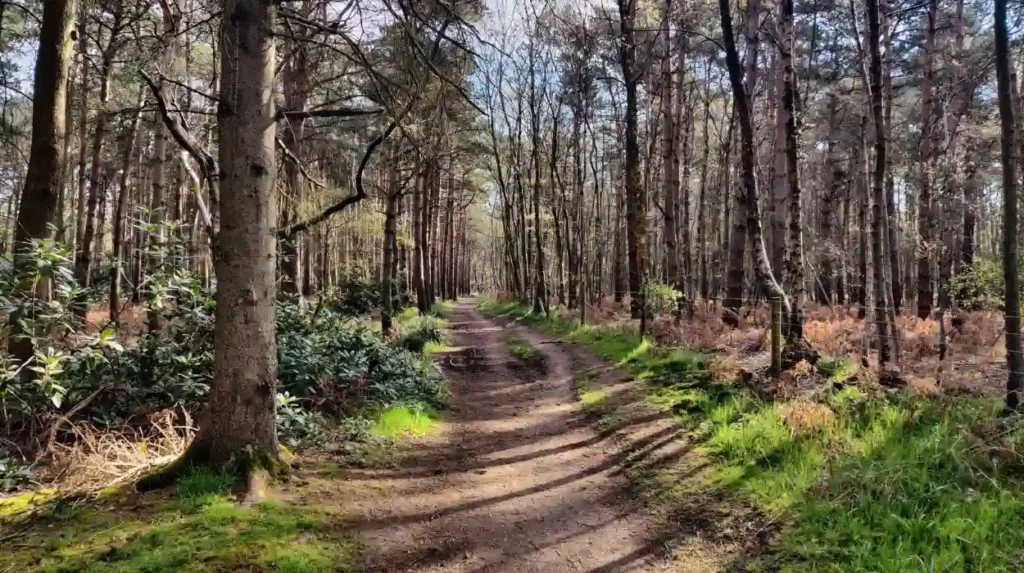
How does tree cover contribute to health and wellbeing?
Tree cover contributes to public health by providing shade, improving the experience of outdoor spaces and creating opportunities for walking, exercise and relaxation. These benefits depend on accessible green spaces, safe routes and the quality of the surrounding environment.
Urban trees influence health through both environmental and social pathways. Shade reduces direct exposure to sunlight, while cooler outdoor spaces make walking and other activities more comfortable during hot weather. Trees also improve the setting of parks, footpaths and residential streets.
Access to green space is associated with physical activity and mental wellbeing. Tree-lined routes encourage people to spend time outdoors, while woodland and park environments provide opportunities to take breaks from busy streets and buildings.
Barnet Council recognises connections between trees, green space and human health and wellbeing. Its published information also identifies shade, noise reduction and the contribution of vegetation to more comfortable urban environments.
Why does access to shade matter?
Shade is particularly important for children, older people, outdoor workers and anyone spending extended periods outside in hot weather. A tree canopy over a seating area or walking route reduces direct solar exposure.
However, not every tree provides the same level of protection. Canopy size, sun angle, surrounding buildings and the time of day influence shade. Visitors should continue to follow heat-safety guidance, including drinking water and avoiding prolonged exposure during extreme temperatures.
How does tree cover benefit visitors and workers?
Tourists benefit from shaded routes between attractions and from access to parks during sightseeing trips. Domestic business travellers can use green spaces for walking breaks between meetings, while remote workers benefit from nearby outdoor spaces during breaks from indoor work.
Trees also contribute to the everyday experience of residents travelling on foot. Their value is therefore not restricted to designated parks; street trees and garden vegetation form part of the wider network of accessible green surroundings.
How do trees help reduce noise and improve neighbourhood environments?
Trees contribute to neighbourhood quality by providing visual screening, creating greener streets and supporting more comfortable public spaces. Their direct noise-reduction effects depend on vegetation density, planting width and site design, so trees work best alongside other noise-control measures.
Traffic noise affects many urban neighbourhoods, particularly those near busy roads and junctions. Trees and shrubs provide a visual buffer between roads and buildings, while wider planted areas help integrate green infrastructure into residential environments.
A narrow line of trees does not necessarily reduce traffic noise substantially. Effective acoustic barriers require suitable height, density, width and placement. Solid barriers, lower traffic speeds and quieter road surfaces address noise through different mechanisms.
Trees also improve the appearance and usability of public spaces. A street with healthy trees offers shade, seasonal changes and visual continuity. These features support the character of residential areas and walking routes.
Barnet Council lists reduced noise, shelter, privacy and improved neighbourhood conditions among the benefits associated with trees. It also identifies their contribution to property values, although the effect of trees on individual property prices varies with location and market conditions.
How does tree cover contribute to climate change mitigation?
Trees help mitigate climate change by absorbing carbon dioxide during photosynthesis and storing carbon in their trunks, branches, roots and surrounding soils. They also support climate adaptation by providing shade, cooling urban surfaces and helping manage rainfall.
Climate mitigation and climate adaptation are related but distinct processes. Mitigation reduces greenhouse gas emissions or removes carbon dioxide from the atmosphere. Adaptation reduces the harm caused by climate impacts, including heatwaves and intense rainfall.
Trees absorb carbon dioxide as they grow. Some of this carbon remains stored in woody tissues and roots for years or decades. Carbon also enters soils through fallen leaves, branches and other organic material.
The amount stored depends on tree species, age, growth rate, health and management. Tree planting therefore delivers long-term carbon benefits when trees survive, grow and remain healthy. Removing mature trees releases some stored carbon over time and reduces future carbon absorption.
Barnet’s tree policy links tree planting with environmental resilience and the borough’s wider climate commitments. The council’s programme has included replacement planting, additional trees in green spaces, action against urban warming and planting in areas with poor air quality.
Why is retaining mature tree cover important?
Mature trees already provide established canopy, habitat and environmental benefits. Newly planted trees require time to develop comparable crowns. Retaining healthy mature trees therefore protects benefits that replacement planting does not immediately reproduce.
Tree preservation must still consider structural condition, disease, public safety and the suitability of each location. Good management balances these requirements with the environmental value of established trees.
Long-term climate planning also requires species diversity. Planting a mixture of suitable tree species reduces reliance on a narrow range of trees and improves resilience against pests, diseases and changing weather conditions.
How does Barnet manage tree planting and tree protection?
Barnet Council manages tree cover through tree policies, planting programmes, replacement planting and decisions about tree maintenance and protection. Its approach includes expanding canopy, supporting environmental benefits and maintaining trees safely across streets and public green spaces.
The council’s Tree Policy 2023–2028 sets out priorities for managing the borough’s tree resource. A council announcement in 2023 described a strategic programme aiming to plant 1,000 trees annually, reaching 5,000 trees by 2028. This is a published programme target, not confirmation that all 5,000 trees have already been planted.
Barnet’s replacement-planting approach also addresses the loss of trees. Its published policy describes a three-year cycle in which 50% of trees removed during a financial year are replaced in that year, 25% in the second year and the final 25% in the third year. The council’s policy documents provide the relevant context for these arrangements.
What determines where new trees are planted?
Tree planting decisions involve several practical and environmental considerations. These include available rooting space, underground utilities, pavement width, visibility for road users, soil conditions and the expected size of the mature tree.
Barnet’s stated planting priorities include strengthening green spaces, replacing removed trees, addressing urban warming and targeting areas with poor air quality. Suitable species and planting locations help ensure new trees deliver environmental benefits without creating avoidable maintenance or infrastructure problems.
How does tree protection affect development?
Development can affect trees through direct removal, damage to roots, soil compaction and changes to drainage. Protecting established trees requires early assessment of their location and condition, particularly when construction involves foundations, roads or underground services.
Tree preservation orders (TPOs) are legal instruments used by local planning authorities in England to protect specified trees or groups of trees. Conservation-area rules also provide controls over certain tree works. The applicable requirements depend on the tree’s location, its protection status and the proposed work.
People planning building work in Barnet should check the council’s current planning and tree-protection guidance before removing or pruning trees. Legal protection does not apply identically to every tree, and permission requirements vary according to the circumstances.
What challenges threaten tree cover in Barnet?
Barnet’s tree cover faces pressures from development, tree disease, drought, storm damage, restricted rooting space and the loss of mature trees. Addressing these pressures requires consistent maintenance, suitable planting locations, species diversity and protection of established canopy.
Trees are living infrastructure. Their condition changes with age, weather, pests, disease and surrounding land use. Urban trees also face conditions that differ from natural woodland, including compacted soils, limited rooting areas and exposure to vehicle emissions.
How do development and infrastructure affect trees?
Construction can remove trees directly or damage them indirectly. Excavation near roots, storage of heavy materials, changes to ground levels and soil compaction can reduce a tree’s ability to absorb water and nutrients.
Street trees also require adequate space for trunks, roots and future canopy growth. Poorly designed planting pits restrict establishment and reduce the likelihood that new trees will develop into healthy mature specimens.
Effective planning assesses existing trees before construction begins and provides suitable protection during works. Replacement planting is important, but retaining healthy mature trees remains valuable because young trees take time to establish equivalent canopy.
How do climate and disease affect tree survival?
Hotter summers and prolonged dry periods increase water stress in many urban trees. Intense storms damage branches and trunks, while pests and diseases affect particular species.
Diversifying tree planting reduces the risk that one disease or environmental pressure will affect a large proportion of the borough’s canopy. Selecting species suited to local soil conditions and expected future climate also improves establishment and long-term survival.
Tree maintenance includes inspection, appropriate pruning, watering during establishment and monitoring for disease. These activities protect public safety while helping trees deliver environmental benefits throughout their lives.
Explore More Area Guide
Barnet Council: Nature Conservation and Green Spaces Guide
Woodland in Barnet: Best Forests and Nature Walks Guide
How can residents and visitors help protect Barnet’s trees?
Residents and visitors help protect Barnet’s trees by respecting planted areas, reporting damaged public trees through appropriate council channels, supporting suitable community planting and avoiding activities that damage roots or bark. Consistent care helps preserve canopy and improve future tree establishment.
Tree protection involves more than planting additional trees. Existing trees require space, suitable soil conditions and protection from physical damage. People using parks and public spaces can support these requirements through everyday behaviour.
Residents with private gardens can retain healthy mature trees where appropriate, plant suitable replacements and avoid unnecessary soil compaction around roots. Garden owners should also consider the mature size of a tree before planting near buildings, boundaries or underground services.
Visitors can help by keeping to designated paths where required, avoiding damage to tree trunks and branches, and disposing of litter responsibly. Anyone noticing a fallen tree, dangerous branch or significant damage to a public tree should report it to the responsible landowner or council.
Community planting projects also support local environmental awareness. Successful projects need suitable species, adequate planting space, watering arrangements and plans for long-term maintenance. Planting without aftercare often leads to poor establishment and the loss of young trees.
For visitors exploring Barnet, observing the differences between street trees, parkland and woodland provides a practical way to understand how the borough’s green infrastructure works.
What does the future of tree cover mean for Barnet?
The future of tree cover in Barnet depends on protecting established trees, expanding canopy in suitable locations and maintaining healthy, diverse planting. Long-term planning must address rising temperatures, biodiversity loss, surface-water management and unequal access to shaded green spaces.
Barnet’s environmental future depends on both the amount and the distribution of its tree cover. Borough-wide percentages provide a useful overview, but neighbourhood-level information reveals where additional canopy would provide the greatest benefit.
The borough’s 2024 sustainability assessment reported that canopy cover varied between wards. For the 2019–2021 period, Hale and East Finchley recorded the highest figures at 28.7%, while Edgware recorded the lowest at 12.5%. These are historical ward-level measurements and should not be interpreted as current figures without updated verification.
Such differences demonstrate why planting strategies need local evidence. Areas with limited shade, high exposure to traffic pollution or significant heat risk have different priorities from neighbourhoods that already have substantial mature canopy.
Future monitoring should consider canopy cover alongside tree health, survival rates, habitat quality and access to green space. Mapping tools from the Greater London Authority provide a way to examine public trees and canopy distribution across London.
Barnet’s tree cover is therefore an environmental resource that requires long-term management. Mature trees protect existing benefits, new trees help prepare the borough for future conditions, and connected green spaces support wildlife and public access.
For residents, visitors and businesses, the importance of tree cover extends throughout everyday life. It influences the temperature of outdoor spaces, the quality of habitats, the handling of rainfall and the experience of travelling through local neighbourhoods. Protecting and improving this resource supports a greener and more climate-resilient Barnet.
What is tree cover in Barnet?
Tree cover in Barnet refers to the area covered by tree crowns across parks, gardens, streets, woodlands and other land. It contributes to air quality, urban cooling, wildlife habitats and rainwater management.